APQ Optical Design
We believe that the latest CMOS sensors require innovative optical designs capable of meeting increasingly demanding image-quality requirements.
Visual observers also benefit from the newly developed Fluorite Quadruplet Polychromats: unlike most apochromats, their Strehl ratio does not fall toward or below the diffraction limit at the edges of the visual spectrum.
The optical design of our new astronomical objectives is described in detail below. It was developed by Uwe Laux, Dipl.-Ing. (FH) in Technical Optics (for details, see Laux, Uwe: Astrooptik. Optik-Systeme für die Astronomie. 3rd revised and amended edition, 2017, pp. 146-155 and the related patent application).
- Objectives
- Quadruplet
- Strehl
- Blocking
- Professional
- Oil spacing
- AR Coating
- 150/1200
- Designs
During the development of a new generation of astronomical objectives, it quickly became clear that the classic apochromatic triplet design can exploit only part of the full UBVRI spectral range (365 nm – 1014 nm) of modern electronic sensors (CCD, CMOS).
Complementary optical design and system engineering services at Drei Gleichen Engineering
Our objective for the new generation was therefore to develop a design capable of essentially aberration-free imaging across this broad spectral range. Several conditions must be met to achieve this.
Continue readingIn a state-of-the-art triplet apochromat, the particularly troublesome Gaussian error (spherochromatism) cannot be fully corrected.
Only when the sine or isoplanatic condition is satisfied can an optical system form an aberration-corrected image. Such an objective is referred to as an aplanatic objective.
The polychromatic image quality is not artificially altered or made to appear more favorable through calculation, because this would not improve the optical correction itself. Instead, the optical system is optimized from 365 nm to 1014 nm using a wavelength table with an equal weighting factor of 1 for each wavelength.
The result is a four-element polychromatic base system in which the CaF₂ element is protected between two elements made of special optical glasses.
The four-element configuration of the polychromatic objective is particularly suitable for larger refractors with apertures of about 130 mm and above. It permits particularly effective correction of longitudinal chromatic aberration and spherochromatism.
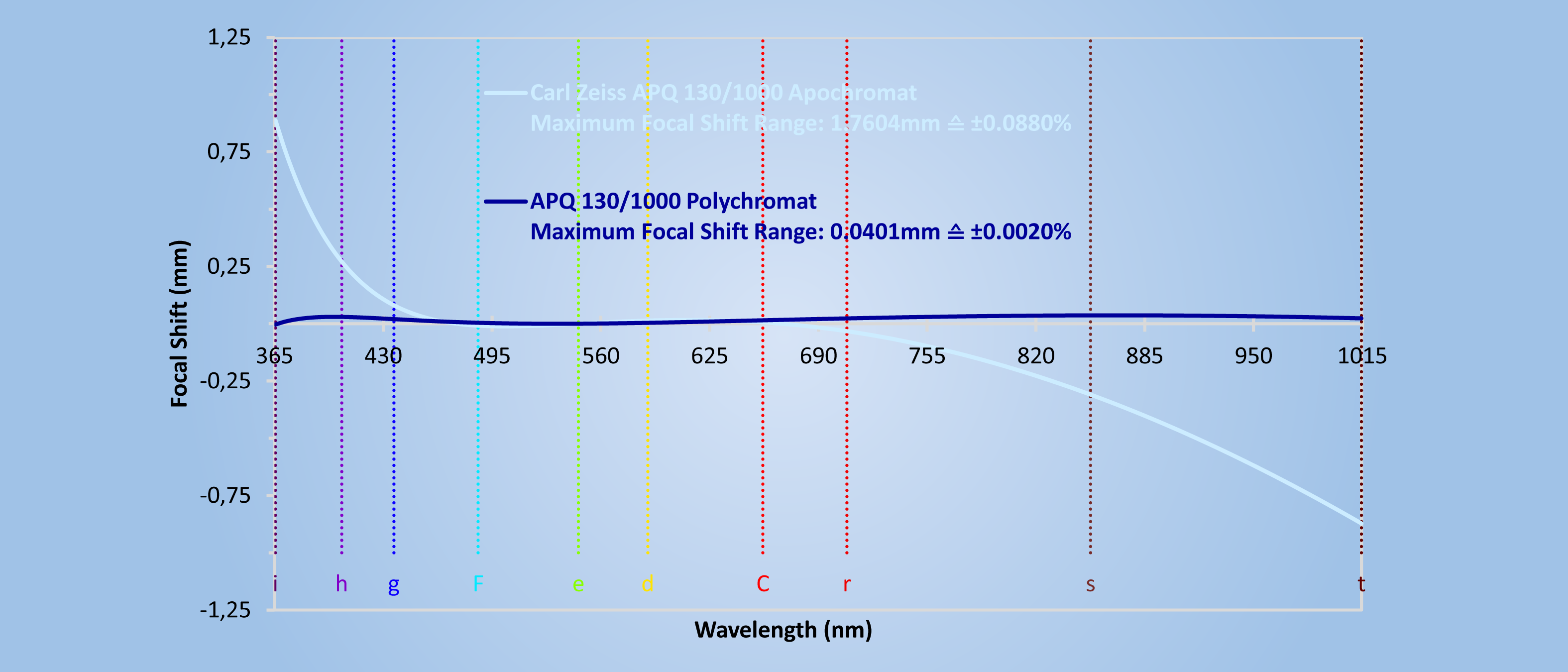
Continue readingThe longitudinal chromatic aberration shows the characteristic behavior of polychromatic correction: the curve crosses the mean image plane at more than three wavelengths.
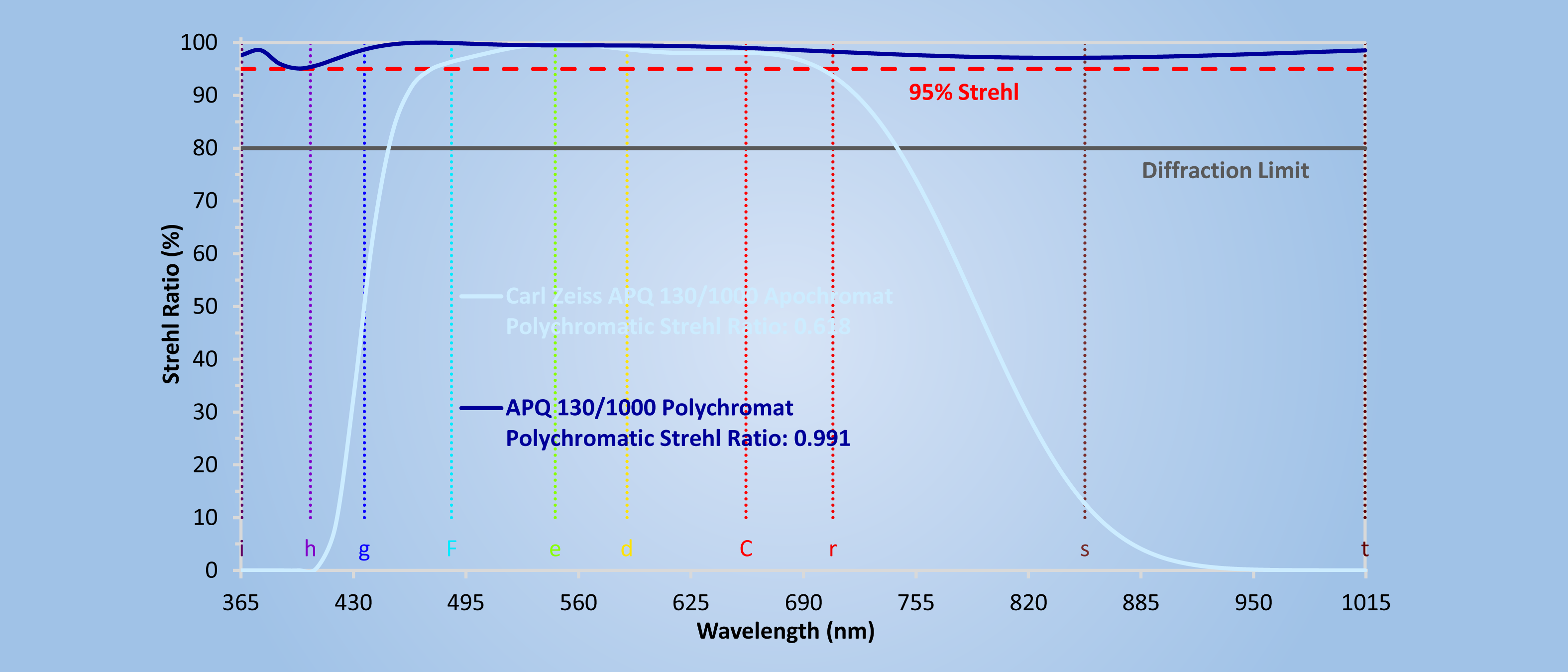
This optical design meets our goal of diffraction-limited image quality, expressed as a Strehl ratio ≥ 0.9 across the spectral range from 365 nm (UV) to 1014 nm (IR).
A patent application for the new optical system and design was filed with the German Patent and Trade Mark Office (DPMA) under the title Polychromatisches Objektiv und Verfahren zum Entwurf eines polychromatischen Objektivs, file number 10 2016 123 732.9.
For visual observation and CCD imaging, the design delivers nearly aberration-free performance. Images are bright and virtually free of chromatic aberration, astigmatism, coma, spherical aberration and Gaussian error, allowing resolution to approach the theoretical limit.
For demanding planetary observation in particular, the brilliant, detailed and high-contrast image quality supports very high magnification, making the optical advantage over conventional apochromatic systems readily apparent.
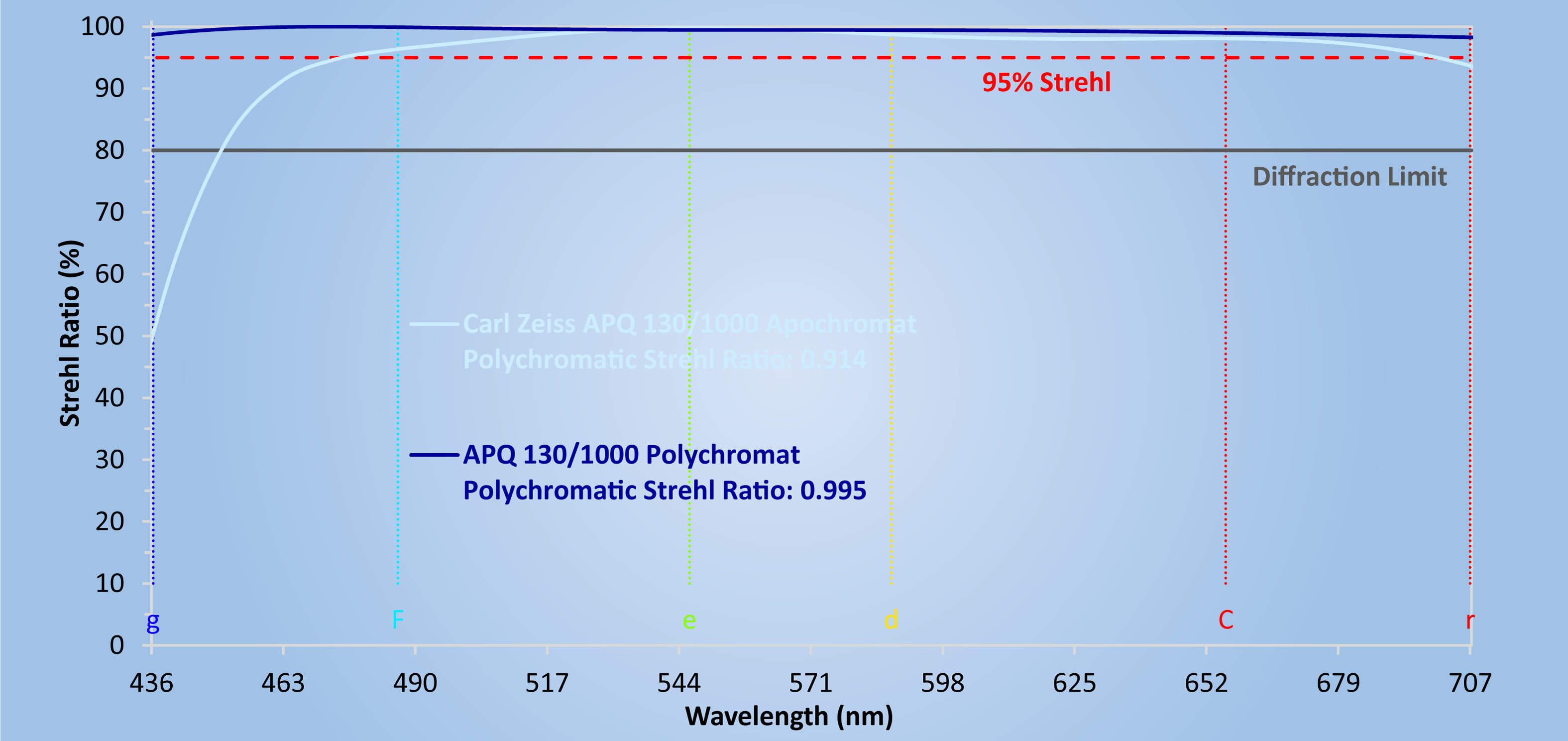
Unlike most apochromats, the Strehl ratio does not fall toward or below the diffraction limit at the edges of the visual spectrum, as illustrated by the following normalization to the 436 nm to 707 nm spectral range:
The four-element Polychromat provides an exceptionally high-quality base system for combination with field correctors and focal-length-modifying systems such as Barlow Systems and Focal Reducer Correctors.
The usable wavelength range extends from 365 nm to 1014 nm and is therefore up to three times broader than the limited visual spectral range of classic apochromatic doublet and triplet objectives (typically 436 nm – 656 nm and 480 nm – 707 nm, respectively).
This gives users access to substantially more spectral information in both the UV and IR while taking advantage of modern CCD and CMOS sensors with large image diagonals, high pixel counts and high quantum efficiency.
Notably, the usable wavelength range of the new Fluorite Quadruplet Polychromat closely matches the spectral sensitivity range of modern CCD and CMOS sensors.
This opens up new fields of research and observation by making structures in the UV and IR accessible that are not visible in the conventional visual spectral range.
Apochromatic fluorophosphate and CaF₂ doublet and triplet objectives generally require UV/IR blocking filters to suppress spectral components outside their optimized visual range.
Because these apochromats are designed for the visual spectral range, spectral components outside that range generally have to be filtered out to obtain a sufficiently sharp image.
Continue readingBy contrast, with Fluorite Quadruplet Polychromats such UV/IR blocking filters are not only unnecessary but can be counterproductive, because they remove spectral information from the observed object.
Starting from the four-element base design, Polychromats with focal ratios from f/1 to f/8 can be derived by adding elements, replacing optically transparent coupling fluids with air gaps, using aspheric glass-to-air surfaces, or substituting crystalline and other special optical media for conventional optical glasses.
Continue readingApplications for these special Polychromats include astrographs and other systems with usable spectral ranges from 320 nm to 2500 nm, such as specialized echelle spectrographs, focal-reducer systems and camera systems for modern professional astronomy.
Oil-coupled assembly, in which an optically transparent fluid fills the spaces between lens elements, offers several advantages over conventional air-spaced construction:
The coupling oil prevents thermally induced stress between adjacent lens elements.
The oil film prevents relative surface tilt of the kind that can occur with an air space.
Continue readingFewer glass-to-air surfaces reduce stray light and increase the transmission of the optical system.
The optical system reaches ambient temperature more quickly, improving its thermal behavior.
Conventional anti-reflection (AR) coatings do not fully match the wide spectral performance of the polychromatic objectives because they are generally optimized only for the visual spectral range.
We therefore commissioned the development of a new ultra-broadband AR coating for the Fluorite Quadruplet Polychromats, characterized by an extremely low average residual reflectivity RAVG of < 0.7 % across the entire spectral range from 365 nm (UV) to 1014 nm (IR).
In the version with an asphere and no air spaces, the four-element Polychromat has only two external glass-to-air surfaces. Together with the ultra-broadband AR coating, this reduces residual reflections to a physical minimum.
Continue readingThe combination of CaF₂, with its high transmission from the UV into the IR, and oil-coupled construction without air spaces further increases system transmission and minimizes reflections.
Currently available AR-coating technology limits the spectral range usable in practice to 365 nm to 1014 nm.
Special UV or IR AR coatings can be offered as options for specialized applications.
A Fluorite Quadruplet Polychromat can be implemented in several configurations. The individual variants cannot be discussed in detail here; see the relevant patent application.
The design variant presented here, a fully oil-spaced APQ 150/1200 Fluorite Quadruplet Polychromat with an asphere, 150 mm clear aperture and 1200 mm focal length, corresponds to the configuration of the first prototypes manufactured.
The wavelength-dependent Strehl curve shows that a Strehl ratio of ≥ 0.9 extends beyond the 365 nm (UV) to 1014 nm (IR) spectral range.
It also demonstrates very good polychromatic correction from the ultraviolet into the infrared, with diffraction-limited performance from 365 nm to at least 1365 nm.
The theoretically usable wavelength range of this four-element polychromatic objective exceeds 1000 nm and is therefore three to four times broader than that of conventional doublet and triplet apochromats.
In practice, currently available AR-coating technology limits the usable spectral range to 365 nm to 1014 nm.
Continue readingIn the wavelength range from 365 nm to 1365 nm, the APQ 150/1200 Fluorite Quadruplet Polychromat with an asphere has a polychromatic Strehl ratio of 0.988 and a maximum focal shift range of ±0.007 %:
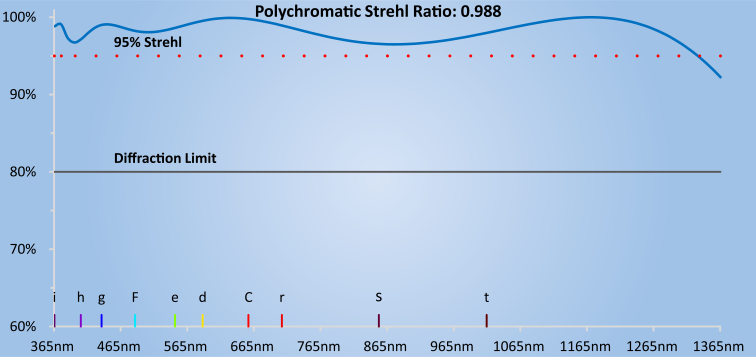
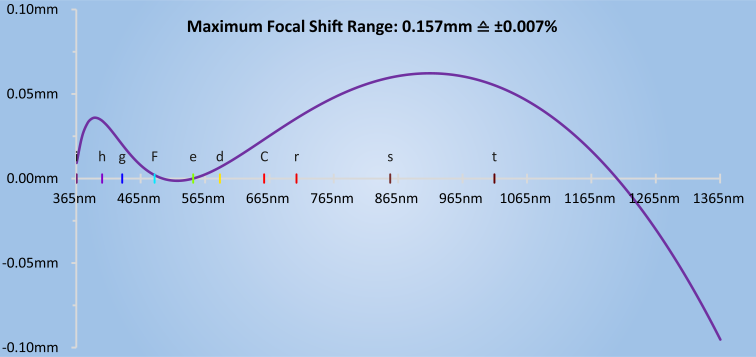
From 365 nm to 1014 nm, the polychromatic Strehl ratio is 0.988 and the maximum focal-shift range is ±0.003 %.
Producing the first two prototypes of the oil-spaced APQ 150/1200 Fluorite Quadruplet Polychromat with an asphere, 150 mm aperture and 1200 mm focal length was a particularly demanding undertaking.
The four-element architecture – with or without an asphere, fully oil-spaced or with air spaces, and with focal ratios from f/5.6 (f/3.9 with a 0.7× Focal Reducer Corrector) to f/15 (as a replacement objective for the Coudé refractor AS 150/2250) – provides broad design flexibility for visual and photographic applications.
After demonstrating the practical feasibility of the APQ 150/1200 Fluorite Quadruplet Polychromat, we will continue to expand our portfolio.
This includes both smaller and, in particular, larger apertures, with focal ratio and AR-coating options where technically feasible.
The following table presents several possible Fluorite Quadruplet Polychromat configurations that achieve a polychromatic Strehl ratio > 0.95 over the 365 nm to 1014 nm spectral range at various focal ratios.
(mm)
(mm)
(%)
1 D…Aperture
2 f…Focal length
3 D/f…Focal ratio
4 Sp…Polychromatic Strehl ratio
5 LCA…Maximum focal shift range